

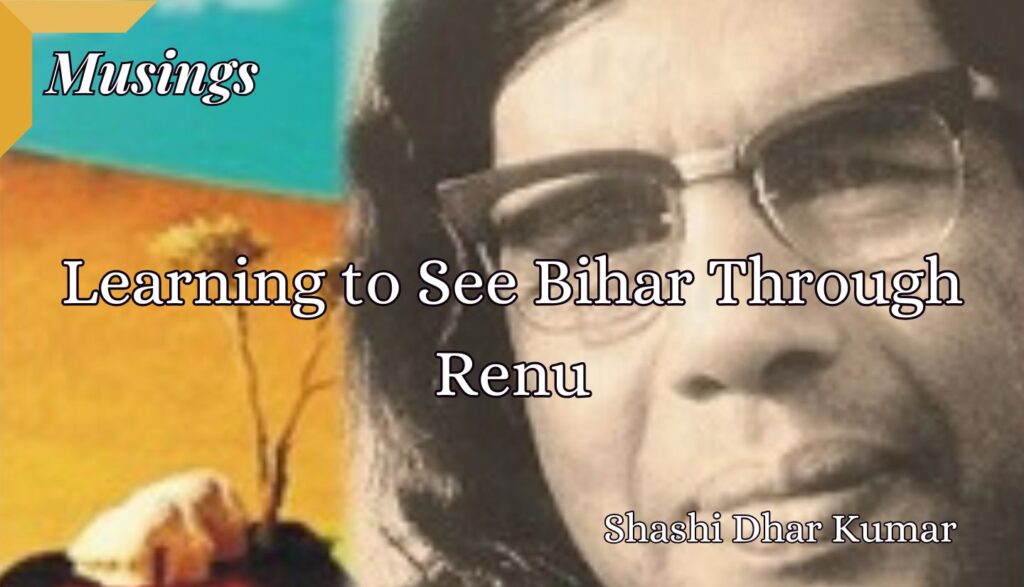
Every writer has a literary figure who does more than influence his writing—they change the way he looks at life. For me, that writer is Phanishwar Nath ‘Renu’. Reading Renu has taught me to see Bihar not merely as a geographical region, but as a living world of people, memories, struggles, traditions, emotions, and dreams.
What attracts me most towards Renu is his honesty. He does not show rural Bihar as an ideal, peaceful village where everyone lives happily, nor does he reduce it to poverty and backwardness. He shows it as it really is—a world full of contradictions. There is poverty, but there is also humour. There are social divisions, but there is also a sense of community. There are hardships, but dreams and hopes too.
This is exactly the kind of writing I want to learn.
When I read Maila Anchal, I felt that Renu is not simply describing a village; he is making the village speak. Through Maryganj and its people, he brings out the realities of rural Bihar—disease, poverty, caste, politics, social relationships and the desire for change. What stays with me is not only the plot, but the feeling that these people have real lives beyond the pages.
That has made me look at the people and places around me differently. I have started believing that a writer does not always need an extraordinary event to write something meaningful. Sometimes a farmer returning home after a long day, an old man sitting quietly at a tea stall, children playing near a muddy road, a crowded village fair, or a family waiting anxiously for the monsoon can contain an entire story.
Renu’s Panchlight makes this lesson clearer to me. A simple lantern becomes the centre of a village’s pride, relationships and emotions. I find this fascinating because it shows how a small object or an ordinary incident can reveal something much larger about human nature.
I also feel a strong connection with Teesri Kasam. Hiraman’s journey with Hirabai is simple on the surface, but beneath it lie innocence, affection, social boundaries and the sadness of unfulfilled emotions. The bullock cart, the fair, the folk songs and the roads are not just scenery. They create the emotional world of the characters. When I read it, I realised how deeply a person’s surroundings can become a part of his or her identity.
Perhaps what influences me most is Renu’s language. He was not afraid to bring the language of ordinary people into literature. Local words, expressions, songs and dialects give his writing a rhythm that feels alive. His characters do not sound like people created for a textbook; they sound like people one could actually meet.
This has changed the way I think about my own writing. If I write about Bihar, I do not want to write about it from a distance. I want to notice its small details. I want to hear the conversations people have; understand the humour hidden in their speech; observe their struggles and capture the emotions that may never appear in official descriptions of rural life.
At the same time, I know that the Bihar I write about is not exactly the Bihar Renu knew. Villages are changing. Young people are migrating to cities, mobile phones have entered everyday life, education is creating new aspirations, and social relationships are changing. Yet the old memories, traditions, inequalities and attachments to the land have not disappeared completely. This meeting of the old and the new is something I want to explore in my own writing.
Renu inspires me because he gives importance to people whom literature can easily overlook. He makes me feel that the voice of a farmer, a village woman, a traveller, a labourer or an ordinary young person is worthy of being heard.
For me, writing, after reading Renu, is therefore not simply about using beautiful words. It is about looking closely and telling the truth of what I see.
If I ever succeed in writing a poem, story or article that makes a reader feel the soil of Bihar beneath their feet, hear the sounds of its villages and understand the lives of its ordinary people, I will feel that I have learned something important from Renu.
He has taught me to look for literature where I once saw only everyday life. And that, perhaps, is the greatest inspiration a writer can receive.
Shashi Dhar Kumar

0 Comments