
Sometimes the greatest barrier a person encounters is not a staircase, but another person’s gaze. We live in a world that quickly reduces someone to a wheelchair, white cane, hearing aid or different way of speaking, allowing one visible characteristic to become the whole story. But no human being is one thing.
A wheelchair may tell us something about mobility. It tells us nothing about the person’s favourite music. Nothing about whom they love. Nothing about whether they are impatient, funny, stubborn, shy, ambitious, romantic, brilliant at mathematics or terrible at cooking. It does not tell us what makes them laugh at two in the morning. It does not tell us their dreams. Yet people with disabilities are still too often approached through two extremes: pity or extraordinary admiration.
Neither is equality. A person should not have to become an “inspiration” simply for studying, working, travelling, raising a family, creating art or living an ordinary day. Sometimes an ordinary life is exactly what a person is asking the world to allow. Real inclusion begins when we stop expecting gratitude for basic accessibility.
A ramp is not kindness. Accessible transport is not generosity. Communication that people can use is not a special favour. The possibility of entering a school, workplace, theatre, restaurant or public institution with dignity should not depend upon somebody else’s goodwill. These are questions of participation and equal access.
Language matters too. So does listening. Different people prefer different terminology when speaking about themselves, and respect sometimes begins with something remarkably simple: asking rather than assuming. Perhaps we need to ask more often: What do you need? Would you like help? And then accept the answer—even when the answer is no. There is dignity in assistance when assistance is wanted. There is dignity in independence. There is also dignity in interdependence, because none of us moves through life entirely alone. We all depend on someone eventually.
A child depends on hands that lift them. An adult depends on people they trust. An elderly person may one day need help with things they once did without thought. Human vulnerability is not an exception to life. It is part of life. And perhaps that is why inclusion concerns everyone.
The world becomes more humane when it is designed with different bodies, senses, minds and ways of communicating in mind. Not because every person is the same. We are not. Equality does not require sameness. It requires that difference is not used as a reason to make someone smaller. So, when we meet a person whose body or way of experiencing the world differs from our own, perhaps the first question should not be: “What happened to you?” Perhaps we should begin where every human encounter deserves to begin–with a name; with respect; with conversation; with enough patience to discover the person before deciding we already know their story.
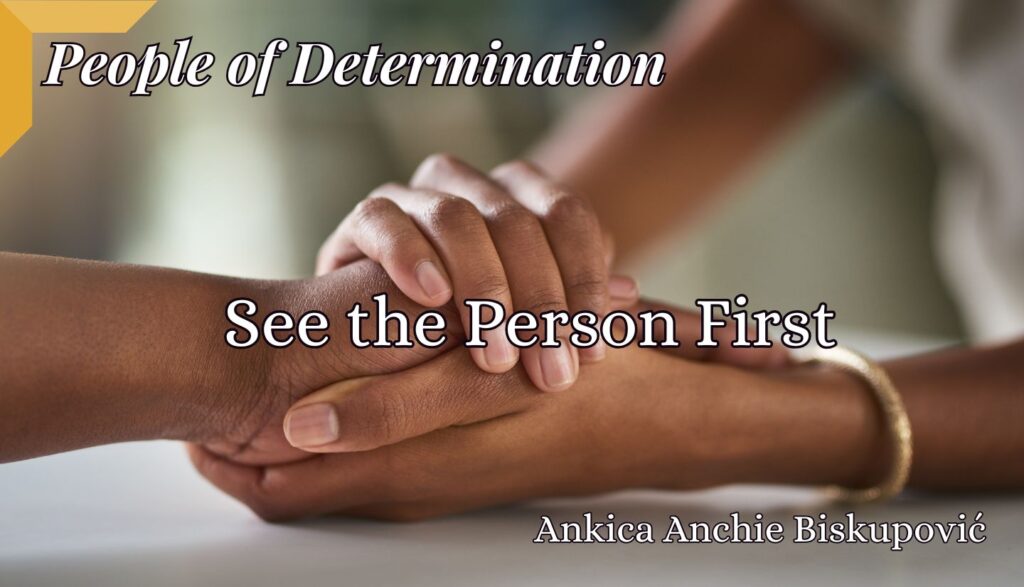
See the person first. Everything human begins there.
Ankica Anchie Biskupović

0 Comments