

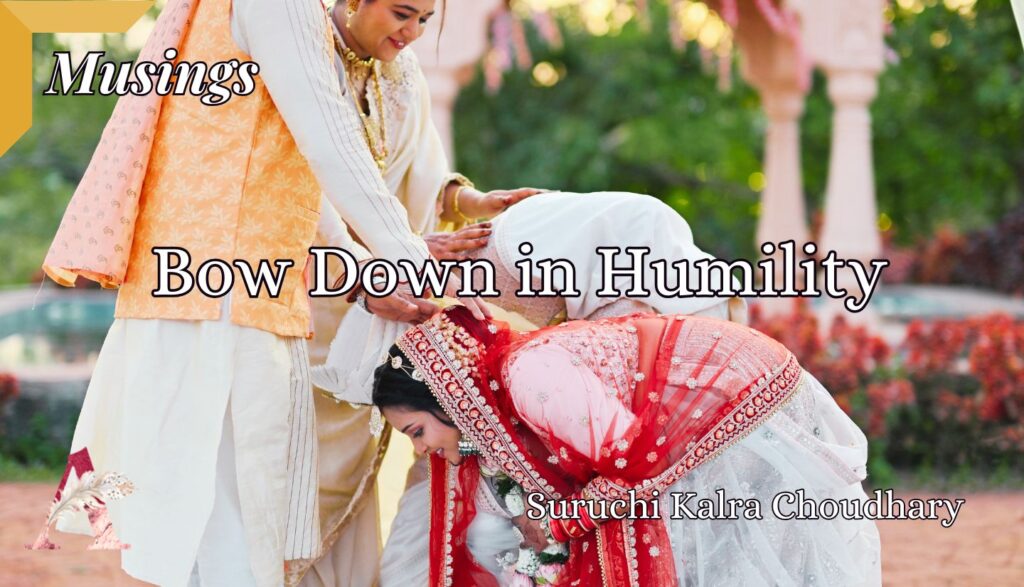
On returning from her friend’s ‘Roka’ ceremony, my daughter commented that she found it very strange that her friend was being introduced to her would-be in-laws and she was bending down all the time to touch their feet. Why do daughters-in-law touch the feet of elders, while daughters don’t?
During summer vacations, I enrolled my kids for roller skating in the stadium. Their coach taught them warm-up exercises, skating, stretching exercises and greeting. The boys would bow down and touch their coach’s feet before departing. This habit automatically extended to parents of fellow players. I feel so proud of my boys that they inculcated this traditional custom at a tender age, and they respectfully touch the feet of their elders.
‘Charan Sparsh’ is a cultural practice. As a mark of respect to the reverend, you bend and touch the feet. This gesture of humility brings blessings. The ancient Indian scripture Atharva Ved extols the importance of touching the feet of wise and elderly. Thereby, a person learns to be humble, courteous and respectful. In the Vanaparv of the Mahabharata, Yudhishthir, the exponent of Dharma, tells Yaksha that by touching the feet of parents, teachers and elders, one receives blessings which make one strong and great.
A quote inscribed in the Manusmriti describes Brahmanjali, the ideal procedure. One must touch the right foot with the right hand and the left foot with the left hand with humility and devotion. As one bends down, a healthy chakra is formed, there is a flow of energy, and positive vibrations are released. The physical effort involved is a useful exercise and promotes motivating enthusiasm.
According to the Hindu religion, a daughter is a reflection of Goddess Lakshmi and hence is not allowed to touch the feet. But as she enters matrimony, the social norms expect her to integrate into her extended family. While it might seem patriarchal, the broader societal practice is an act of affirmation of her familial acceptance and her progression to adulthood. She receives blessings as she enters the holy wedlock and embraces the role of a nurturer to perpetuate progeny to carry on the lineage.
Call it archaic or cliché or regressive, I endorse the practice. A string of blessings flows when my nephew says ‘pairi pauna’ even on the phone. While in our Punjabi families, it is at times a customary gesture only, a little bend of the waist, an extended hand and some magical words, in some communities, the practice is on another level. The exponent presses your feet right up to your knees, giving you a massage kind of feeling. The gesture is so soothing, and blessings automatically flow from the depths of your heart.
‘Charan Sparsh’ is a gesture rooted in our heritage. There lives an adherent goodness in every human creation of the Almighty. The soul is a manifestation of the Creator. To receive blessings, let us bow down in humility.
Suruchi Kalra Choudhary

0 Comments